What Is Refrigerant Recovery and Why It’s Required (2026)
TL;DR
Refrigerant recovery is the process of removing refrigerant from an HVAC system and storing it in an external container. Federal law requires it under Section 608 of the Clean Air Act because venting refrigerants destroys the ozone layer and accelerates global warming. Technicians must hold EPA 608 certification to legally perform recovery, and penalties for violations can reach $60,000 per day per violation. With HFC phasedowns accelerating under the AIM Act, recovery skills are more valuable now than ever.
Refrigerant Recovery: Definition
According to the EPA’s regulations under 40 CFR Part 82, Subpart F, recover means to remove refrigerant in any condition from an appliance and store it in an external container without necessarily testing or processing it in any way.
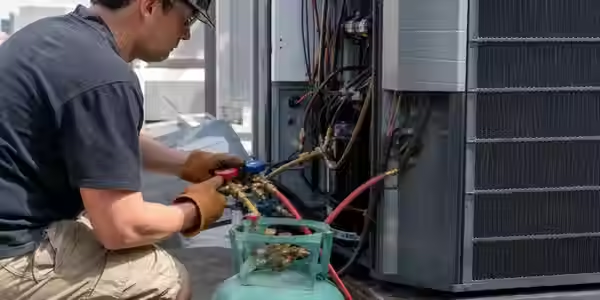
In plain language, refrigerant recovery is the act of pulling refrigerant out of an air conditioning or refrigeration system before you open it up for service, repair, or disposal. The refrigerant goes into a certified recovery cylinder, where it sits until it’s reused, recycled, or sent out for reclamation.
This isn’t optional. It’s not a best practice or a suggestion. It’s a federal requirement that applies every time a technician works on a system’s refrigerant circuit.
If you’re new to the HVAC field and want broader context on HVACR fundamentals, understanding refrigerant recovery is one of the first and most important things you’ll need to learn.
Recovery happens in several common scenarios:
System repairs where the refrigerant circuit must be opened (replacing compressors, evaporators, condensers, or coils)
Equipment disposal or decommissioning, where all refrigerant must be removed before the unit goes to scrap
Retrofit projects where the system is being upgraded to a different refrigerant type
Leak repairs where refrigerant must be recovered before fixing holes or cracks, then recharged after the repair is complete
Every one of these situations requires proper recovery. No exceptions.
Recovery vs. Recycling vs. Reclamation: What’s the Difference?
This is one of the most commonly confused topics for anyone studying for the EPA 608 exam, and it’s frequently tested. The three terms are legally distinct, and mixing them up can cause problems both on the test and in the field.
The critical rule to remember: if recovered refrigerant changes ownership, it must first be reclaimed to AHRI 700 standards. Recycled refrigerant can only go back into equipment owned by the same person who originally owned the system it came from.
As one HVAC reclamation specialist at A-Gas explains, recovered refrigerant always contains contaminants like air, oil, moisture, acids, and foreign particulates (especially from compressor burnouts). This is precisely why reclamation exists. Recovery alone doesn’t purify the refrigerant.
For a deeper breakdown of these distinctions, check out this guide on refrigerant reuse, reclaim, and recycle. These concepts show up repeatedly on the EPA 608 exam, so a solid Section 608 study guide is worth working through before test day.
Why Refrigerant Recovery Is Required by Law
Understanding what is refrigerant recovery and why it’s required means understanding the legal framework behind it. The requirement isn’t new. It traces back to the early 1990s.
The Clean Air Act, Section 608
EPA regulations under Section 608 of the Clean Air Act require technicians who service stationary refrigeration and air conditioning equipment to follow specific practices designed to maximize recovery and recycling of refrigerants. These substances can be ozone-depleting compounds or potent greenhouse gases, and the law treats their release seriously.
The centerpiece of these regulations is the venting prohibition. It is illegal to knowingly or intentionally vent refrigerants into the atmosphere. The EPA has prohibited this because released refrigerants contribute to ozone layer depletion and increase global warming potential. Anyone removing refrigerant from an appliance must evacuate it to a set level using certified recovery equipment before servicing or disposing of the equipment.
Technician Certification Is Mandatory
The first step to legally recovering refrigerant is obtaining EPA 608 certification. Any technician adding refrigerant to or removing refrigerant from HVAC/R equipment must hold one of four certification types (Type I for small appliances, Type II for high-pressure systems, Type III for low-pressure systems, or Universal covering all three).
This isn’t a recommendation. It’s a prerequisite. Working on refrigerant systems without certification is itself a violation.
Equipment Must Be Certified Too
It’s not just the technician who needs credentials. EPA regulations require that refrigerant recovery and recycling equipment be tested to meet EPA standards. The Air-Conditioning, Heating, and Refrigeration Institute (AHRI) and Underwriters Laboratories (UL) are both approved to certify this equipment. Using non-certified equipment for recovery is a violation.
Environmental Reasons for Refrigerant Recovery
The legal requirements exist because of real, measurable environmental harm. Two separate problems drive the regulations.
Ozone Depletion
Ozone in the upper atmosphere blocks harmful ultraviolet rays from the sun. When chlorine-containing refrigerants (CFCs and HCFCs like R-22) are released, the chlorine molecules destroy ozone. The consequences include increased rates of skin cancer and damage to animal and plant life. This was the original motivation behind Section 608 when it was enacted.
Global Warming Potential
Even newer HFC refrigerants that don’t destroy ozone are staggeringly potent greenhouse gases. Here’s the number that puts it in perspective: a release of just 1 pound of R-410A has the same global warming impact as releasing 1 ton of carbon dioxide.
R-410A, the refrigerant found in most residential AC and heat pump systems, has a global warming potential (GWP) of 2,088. That means it is over 2,000 times more potent than CO2 as a greenhouse gas. Every pound that escapes during sloppy service work or illegal venting does real, measurable damage.
This is why the regulations now apply to all refrigerant types, not just the older ozone-depleting ones. Section 608 refrigerant management requirements cover CFCs, HCFCs, and all their substitutes, including HFCs.
The Upside of Getting It Right
Recovery doesn’t just prevent harm. Reclamation of R-410A can cut greenhouse gas emissions from refrigerant production by more than half compared to manufacturing new refrigerant. Proper recovery feeds the reclamation supply chain, which reduces the need for virgin production.
What Happens If You Don’t Recover Refrigerant?
The penalties for ignoring refrigerant recovery requirements are severe, and the EPA actively enforces them.
Civil and Criminal Penalties
The EPA may assess civil penalties of up to $60,000 per violation per day for knowing violations. This includes improper venting, failure to repair leaks within required timeframes, and inadequate recordkeeping. Criminal penalties apply for intentional venting and can include prison time.
In 2024, refrigerant recovery violations accounted for over 30% of all EPA penalties, making refrigerant handling the single largest compliance failure category in the HVAC industry.
Real Enforcement Cases
These aren’t theoretical threats. Here are actual cases:
Shannon Wayne Harrold of Ohio was sentenced to 54 months in prison and ordered to pay $29,045 in restitution for violating the Clean Air Act by cutting tubing on air conditioning units to release refrigerant.
Derichebourg Recycling USA paid a $442,500 civil penalty after failing to recover refrigerant from appliances at 10 scrap metal recycling facilities before disposal.
Gristedes paid over $400,000 in 2024 for leak repair failures, while Trader Joe’s faced $500,000 in civil penalties plus $2 million in mitigation costs.
Andersen’s Sales and Salvage was required to pay a $195,000 penalty in June 2024 for refrigerant violations.
The message is clear. The EPA pursues both large corporations and individual technicians. Cutting corners on recovery can end a career or bankrupt a business. Knowing what refrigerant recovery is and why it’s required isn’t just academic knowledge; it’s professional self-preservation. Avoiding common EPA 608 exam mistakes starts with taking the regulations seriously.
When Is Refrigerant Recovery Required?
The short answer: whenever you might open a system’s refrigerant circuit. The longer answer covers several specific scenarios.
Component replacement. Replacing compressors, evaporators, condensers, or any sealed system component requires recovering the charge first.
Leak detection and repair. If a system has holes or cracks in its coils, the refrigerant must be recovered before the repair. Once the fix is complete, the system gets recharged.
Equipment disposal. Before any HVAC equipment goes to scrap or recycling, every ounce of refrigerant must be recovered. This is the violation that got Derichebourg hit with a $442,500 fine.
Retrofit to a new refrigerant. When upgrading a system to use a different refrigerant type, the old refrigerant must be completely removed and properly handled before the new type goes in.
Decommissioning. Any time a system is being permanently taken out of service, recovery is required.
Practitioners on HVAC forums are blunt about the temptation to skip recovery when schedules are tight. As one trade school instructor put it, refrigerant recovery technology has improved enormously over 25 years, but many technicians still find it time-consuming. When pressure mounts, the temptation to vent instead of recover is real. That shortcut is a massive mistake, both legally and professionally.
Proper documentation of every recovery matters too. Having a solid recordkeeping checklist for refrigerant transactions protects you during an EPA inspection.
How Does Refrigerant Recovery Work?
This section gives you the essentials. For a full procedural walkthrough on smaller units, see this guide on recovering refrigerant from small appliances.
Three Recovery Methods
Liquid recovery removes refrigerant in its liquid state. This is typically the fastest method and works well for systems with large charges.
Vapor recovery extracts refrigerant in vapor form. It’s slower but necessary when liquid recovery isn’t practical or when finishing off the last portion of a charge.
Push-pull recovery uses both the liquid and vapor ports of a recovery cylinder simultaneously, creating a circulation loop that dramatically speeds up recovery on large commercial systems.
Key Equipment
The core equipment for any recovery includes:
A recovery machine with an internal compressor that pulls refrigerant out of the system
Manifold gauges to monitor pressures
Hoses rated for the refrigerant being recovered
A certified recovery cylinder to hold the recovered refrigerant
Experienced technicians on YouTube share a practical tip that written guides often skip: cooling the recovery cylinder significantly speeds up the process by maintaining a better pressure differential between the system and the cylinder. Temperature management is the number one speed hack among seasoned techs. Another field tip: if you suspect contaminated refrigerant (especially after a compressor burnout), use an inline filter-drier at the recovery machine’s inlet to protect your equipment.
The 80% Fill Rule
Never fill a recovery cylinder beyond 80% of its capacity. This allows room for the refrigerant to expand as temperature changes. Overfilling is a serious safety hazard that can cause the cylinder to rupture. For more on this critical topic, review the guide on recovery cylinder filling limits.
Small Appliances vs. Large Systems
The rules differ based on system size. For Type I (small) appliances with a non-working compressor, EPA Section 608 requires recovering 80% of the charge amount. If the compressor works, the requirement is either 90% of the nameplate charge or evacuation to 4 inches of mercury vacuum.
System-dependent recovery (using the appliance’s own compressor or internal pressure to push refrigerant out) is limited to appliances with 15 pounds of refrigerant or less. For anything larger, an active recovery machine with its own compressor is required.
What’s Changing? The AIM Act and the Future of Refrigerant Recovery
Most existing guides on what refrigerant recovery is and why it’s required were written before the AIM Act reshaped the regulatory picture. Here’s what’s different now.
The HFC Phasedown
The AIM Act of 2020 directs the EPA to phase down HFC production and consumption to 15% of historic baseline levels by 2036, an 85% reduction. This law passed with broad bipartisan support and is already taking effect.
Under the AIM Act, the EPA set a GWP limit of 700 for new residential and commercial air conditioning and heat pump equipment starting in 2025. R-410A, with its GWP of 2,088, no longer qualifies for new systems. Lower-GWP alternatives like R-454B are replacing it.
Tighter Thresholds
Starting in January 2026, the AIM Act expansion lowers regulatory thresholds from 50 pounds to just 15 pounds of HFC refrigerant. This means far more systems and facilities fall under strict tracking, leak repair, and recovery requirements. Facilities that previously flew under the radar now face unprecedented scrutiny.
The 2029 Reclaimed-Only Mandate
Beginning January 1, 2029, servicing and repair of certain refrigeration systems must use reclaimed HFC refrigerants rather than virgin product. This makes the recovery-to-reclamation pipeline essential. Without technicians properly recovering refrigerant today, there won’t be enough reclaimed supply to service existing equipment in a few years.
Why This Matters for Technicians
As virgin HFC supply shrinks, recovered and reclaimed refrigerant becomes the primary available supply for servicing existing equipment. Recovery is no longer just a compliance issue. It’s an economic necessity. Reclaimed refrigerants reduce the need to purchase increasingly expensive new product, and with common shortages of high-demand refrigerants already occurring, the cost savings are significant.
Technicians who understand recovery procedures thoroughly will be in higher demand as these regulations tighten. Understanding leak repair regulations alongside recovery requirements gives you the complete compliance picture.
How to Get Certified for Refrigerant Recovery
You cannot legally recover refrigerant without EPA Section 608 certification. Period. The four certification types are:
Type I covers small appliances (systems with 5 pounds or less of refrigerant)
Type II covers high-pressure systems (most residential and commercial AC)
Type III covers low-pressure systems (large chillers)
Universal covers all three types and is what most professional technicians pursue
The exam tests your knowledge of recovery procedures, environmental regulations, safety practices, and the legal requirements covered throughout this article. The recover/recycle/reclaim distinctions, the venting prohibition, evacuation requirements, and cylinder safety rules all appear on the test.
Getting certified is straightforward with the right preparation. SkillCat offers EPA 608 online certification with training and a proctored exam you can complete on your phone.
Frequently Asked Questions
What is the difference between refrigerant recovery and refrigerant reclamation?
Recovery is simply removing refrigerant from a system and storing it in a container. Reclamation goes further: a certified facility reprocesses the recovered refrigerant to AHRI 700 standards (99.5% purity), making it equivalent to virgin product. Recovered refrigerant can go back into same-owner equipment, but it must be reclaimed before it can be sold or used by someone else.
Do I need EPA 608 certification to recover refrigerant?
Yes. Any technician who adds or removes refrigerant from HVAC/R equipment must hold EPA Section 608 certification. Working without it is a federal violation that can result in fines up to $60,000 per day.
What are the penalties for venting refrigerant instead of recovering it?
Civil penalties can reach $60,000 per violation per day. Criminal penalties include prison time. In one 2024 case, a technician in Ohio received 54 months in prison for cutting refrigerant lines on AC units. The EPA actively investigates and prosecutes these violations.
Can recovered refrigerant be reused?
Yes, but with restrictions. Recovered refrigerant can go back into the same system it came from, or into other equipment owned by the same person. If it needs to change ownership, it must first be reclaimed by an EPA-certified facility to meet AHRI 700 purity standards.
What equipment do I need for refrigerant recovery?
At minimum, you need a certified recovery machine, manifold gauges, hoses rated for the refrigerant type, and a DOT-approved recovery cylinder. The recovery machine and cylinder must both meet EPA certification requirements through AHRI or UL.
Why is the 80% fill rule important for recovery cylinders?
Refrigerant expands as temperature increases. Filling a cylinder above 80% capacity leaves no room for expansion, which can cause the cylinder to rupture. This is a safety rule that is non-negotiable.
How does the AIM Act affect refrigerant recovery requirements?
The AIM Act phases down HFC production by 85% by 2036, which makes recovered and reclaimed refrigerant increasingly important as the supply of new HFCs shrinks. Starting in 2029, certain systems must be serviced using only reclaimed refrigerant. The Act also lowers regulatory thresholds in 2026 from 50 pounds to 15 pounds, bringing more systems under strict compliance requirements.
Is refrigerant recovery required for all types of refrigerants?
Yes. Section 608 requirements apply to CFCs, HCFCs, HFCs, and all substitute refrigerants. Even though HFCs don’t deplete ozone, they are potent greenhouse gases and are fully subject to recovery regulations.