Designing an Onboarding Curriculum for New Maintenance Techs
- 12 minutes ago
- 16 min read
TL;DR
Most maintenance teams confuse orientation with onboarding, which is why 42% of technicians leave within their first two years. Designing an onboarding curriculum for new maintenance techs requires a structured, phased system spanning at least 90 days, covering everything from safety training and CMMS proficiency to mentor pairing and certification milestones. This guide defines every key term, maps them to a practical timeline, and gives you a framework you can actually implement.
The typical onboarding failure in maintenance looks like this: a new tech gets a safety walkthrough, a locker, a set of keys, and instructions to follow Dave around for a few days. By week two, they’re carrying a full workload. By month two, they’re gone.
This is not an exaggeration. In a WrenchWay poll, not a single technician rated their onboarding experience as excellent, and 92% rated it average at best. Meanwhile, research shows that strong onboarding can improve retention by 82% and productivity by over 70%.
The stakes are high. The U.S. Bureau of Labor Statistics projects roughly 157,200 job openings annually for general maintenance and repair workers through 2033. Industrial maintenance employment is expected to grow 15% in that same period. And for every five tradespeople who retire, only two qualified workers are available to replace them. Every new hire you lose to bad onboarding is a loss you cannot afford.
Designing an onboarding curriculum for new maintenance techs is not about making a checklist. It is about building a system with defined phases, competency milestones, and accountability. This glossary gives you the vocabulary and the framework to do it right.
Why This Glossary Exists
Search for “maintenance tech onboarding” and you will find scattered checklists, downloadable PDFs, and vendor blog posts with five tips. What you won’t find is a single reference that defines every component of an onboarding curriculum, explains why it matters, and shows where it fits in the timeline.
That is the gap this guide fills.
Whether you manage a team of apartment maintenance technicians, run a commercial facility, or supervise industrial mechanics, the building blocks of a strong onboarding curriculum are the same. The specifics change. The structure does not.
Before diving into the glossary, one distinction needs to be absolutely clear.
Orientation is not onboarding. Orientation is a single event, usually completed on day one. It covers paperwork, facility tours, and basic safety rules. Onboarding is a multi-month curriculum with phases, training modules, mentor relationships, and formal assessments. Conflating the two is the root cause of most onboarding failures in maintenance.
Glossary: Phases and Frameworks
Onboarding Curriculum
A structured, phased plan of training activities, competency milestones, and assessments designed to bring a new maintenance tech from day-one orientation to independent performance. It is not a binder. It is not a single training day. It is a system that runs for a minimum of 90 days, and many industry experts argue it should extend to a full year.
Joel Levitt, who has trained over 20,000 maintenance professionals, frames it bluntly in ReliaMag: the new tech gets a safety orientation, a locker, and a vague instruction to shadow someone. By day 30, they are running solo on night shift. That is orientation masquerading as onboarding. A real curriculum has defined learning objectives for each week, checkpoints for skill evaluation, and a graduated path to independence.
Preboarding
Everything that happens before the new tech’s first day. This includes completing HR paperwork, ordering PPE and tools, setting up CMMS system access, assigning a mentor, and preparing a written schedule for the first two weeks.
Most shops think onboarding begins when the technician walks through the door. That thinking is outdated. When preboarding is done well, day one starts with hands-on learning instead of hours filling out forms. The new tech feels expected, prepared for, and valued from the start.
30-60-90 Day Plan
The dominant framework for designing an onboarding curriculum for new maintenance techs. It breaks the process into three focused phases:
Days 1 to 30 (Learn): Safety training, facility orientation, CMMS basics, SOP review, shadowing, initial skills assessment.
Days 31 to 60 (Contribute): On-the-job training on real work orders, first solo tasks with mentor backup, cross-training introduction, certification pursuit (EPA 608, OSHA-10).
Days 61 to 90 (Perform): Independent work order completion, competency milestone evaluation, 90-day formal review, creation of an ongoing upskilling plan.
This framework, while simple, works because it prevents the common failure of expecting independent performance by week two. Each phase has clear expectations and measurable outcomes.
Safety Orientation
The non-negotiable first block of any onboarding curriculum. This covers plant and site rules, PPE requirements, lockout/tagout procedures, emergency exits, fire suppression systems, confined space protocols, and chemical handling. Every ranking onboarding checklist reviewed for this guide lists safety orientation as the day-one priority.
Safety orientation is not optional or flexible. It happens before any wrench touches any bolt. For a deeper understanding of safety training standards and OSHA requirements, the specifics of OSHA-10 content are worth reviewing as you design this portion of your curriculum.
Lockout/Tagout (LOTO)
A critical safety procedure ensuring hazardous energy sources are properly isolated and de-energized before any maintenance work begins. LOTO appears on virtually every onboarding checklist in the industry because getting it wrong kills people. New techs must demonstrate LOTO proficiency before touching any energized equipment. This is not a module they watch a video about; it is a procedure they must physically practice under supervision.
OSHA-10 / OSHA-30
Federally recognized safety training programs from the Occupational Safety and Health Administration. OSHA-10 covers general industry safety topics in 10 hours and is widely required or strongly preferred by employers for maintenance roles. OSHA-30 is a more comprehensive program typically aimed at supervisors.
Many employers list OSHA-10 as a “preferred” qualification on job postings. Smarter employers build it directly into the onboarding curriculum so that every new tech completes it during their first 60 days. Mobile-first platforms make this practical even for techs who spend most of their day in the field.
Standard Operating Procedures (SOPs)
Documented, step-by-step instructions for how specific maintenance tasks should be performed at a particular facility. SOPs are the foundation that makes any onboarding curriculum repeatable and consistent across multiple new hires.
As one maintenance training resource puts it: the documentation should outline the who, where, what, and why of daily operations. It should serve as a reference guide that reduces mistakes and eliminates redundant questions. Without SOPs, onboarding defaults to “watch what I do and figure it out,” which produces inconsistent results and extends the learning curve.
Tribal Knowledge
Unwritten expertise that exists only in experienced technicians’ heads. This includes equipment quirks, workarounds for aging infrastructure, non-obvious procedures, and the “why” behind certain maintenance choices.
MaintainX describes the problem clearly: once a new employee gets past the basics of your onboarding program, a knowledge gap often opens up between the person’s existing competency and the unique and precise nature of their work. The BLS reports that across the U.S., manufacturing companies employ as many as 3.9 million people aged 55 or over, leaving many businesses at risk of losing deep organizational knowledge.
The best onboarding curricula include a structured mechanism for capturing tribal knowledge: video recordings of experienced techs explaining their process, annotated SOP additions, and digital knowledge bases accessible from any device.
Mentor Pairing / Buddy System
Assigning a specific experienced technician to guide the new hire through the onboarding period. This is one of the most important decisions in curriculum design, and one of the most commonly botched.
The critical distinction, repeated across practitioner forums and expert writing: the best wrench-turner on the crew is not automatically the best mentor. You need someone who can explain their thought process, tolerate questions, and resist the urge to just do the job themselves. Mentor selection should be based on communication ability, patience, and willingness, not just technical skill.
Job Shadowing
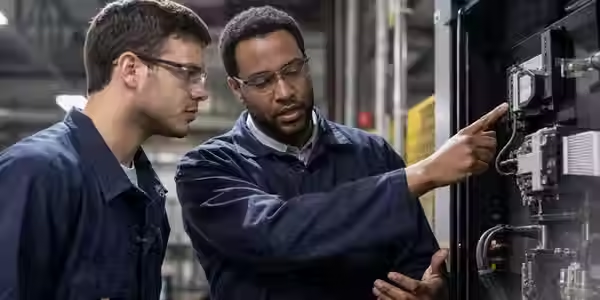
The new tech observes an experienced technician performing real work orders. Shadowing is distinct from mentoring. In the early phase (typically week one and two), shadowing is observation-only. The new tech watches, asks questions, takes notes, and begins to understand the rhythm of the job without the pressure of performing.
The problem with shadowing is when it becomes the entire onboarding curriculum. As PestShare notes, most onboarding processes are too passive. New technicians follow experienced ones, observe, and pick things up over time. It feels natural. It is also inefficient.
Competency Assessment / Skills Assessment
A structured evaluation of what the new tech can and cannot do. This should happen early, ideally within the first one to two weeks. The assessment covers trade-specific skills (electrical, plumbing, HVAC, general repair), tool proficiency, safety knowledge, and CMMS literacy.
The purpose is to customize the rest of the onboarding curriculum. A tech who arrives with HVAC experience but no plumbing background needs a different training path than someone with broad but shallow skills. Assessing competency upfront prevents wasted time on material the tech already knows and ensures critical gaps get filled early.
CMMS Training
Training on the Computerized Maintenance Management System. This covers work order creation, asset lookup, parts lists, maintenance history documentation, and PM schedule navigation. The key: CMMS training must be hands-on, not a 30-minute demo.
Week one should include a session where the new tech creates a practice work order, looks up an asset’s history, and finds a parts list. By week four, they should be entering complete and accurate work order data independently. Bad CMMS habits formed during onboarding create data quality problems that compound for years. For teams evaluating how training platforms connect with their existing systems, understanding LMS integration options for contractor training can help standardize the digital side of your curriculum.
Preventive Maintenance (PM) Schedule
A calendar-driven system of routine inspections and servicing designed to prevent equipment failures. New techs need to understand the PM schedule and their specific role in it within the first 30 days.
This does not mean handing them a printout. It means walking them through the CMMS calendar, explaining which PMs are daily, weekly, monthly, and quarterly, and assigning them to shadow a PM route before performing one independently.
Work Order
A formal task assignment within the CMMS documenting what needs to be done, to what equipment, by when, and with what parts. Teaching new techs to complete work orders properly from day one prevents the accumulation of bad data, missing parts records, and incomplete maintenance histories.
Work order training is where documentation habits are formed. Get it right during onboarding and it stays right.
Cross-Training
Teaching techs skills across multiple trade disciplines: HVAC, plumbing, electrical basics, appliance repair, general carpentry. Cross-training is critical for multifamily and facilities maintenance where technicians handle a wide variety of work orders on any given day.
Cross-training is the release valve. Not to turn every technician into a specialist, but to eliminate single points of failure. A technician does not need to master every discipline. They need enough capability to handle common scenarios without escalation.
Practitioners on Quora recommend HVAC training as a differentiator for apartment maintenance techs, since HVAC skills set you apart from other applicants and the training process touches electrical, plumbing, and general repair along the way. For techs new to the trade, a solid grounding in HVAC/R fundamentals accelerates this cross-training process significantly. Understanding HVAC electrical systems and components is another area where cross-training produces immediate value.
EPA 608 Certification
A federally mandated certification required for any technician who maintains, services, repairs, or disposes of equipment containing refrigerants. EPA regulations under Section 608 of the Clean Air Act make this non-optional for any tech working with HVAC or refrigeration systems.
Many multifamily job listings require EPA certification, and if required at a specific property, certification must typically be obtained within 90 days of the employment start date. This makes EPA 608 a natural fit inside the onboarding curriculum rather than a prerequisite. Smart employers build it into the first 60 days using accessible, low-cost platforms. For a complete breakdown of EPA 608 certification essentials and exam preparation, SkillCat offers EPA-approved training and on-demand proctored exams accessible entirely on a mobile device.
CAMT (Certificate for Apartment Maintenance Technicians)
An ANSI-accredited credential from the National Apartment Association for multifamily maintenance technicians. CAMT covers electrical, HVAC, plumbing, appliance maintenance, system repairs, exterior maintenance, customer service, safety, compliance, and teamwork.
For apartment maintenance technician roles, CAMT is the most recognized industry-specific credential and belongs on any onboarding curriculum’s six-month to one-year certification roadmap.
Make-Ready / Unit Turnover
In multifamily maintenance, the process of preparing a vacated apartment for the next tenant. This includes painting, carpet repairs, cleaning, fixture replacement, appliance checks, and general repairs. Make-ready is a high-volume, high-pressure skill that new techs must learn quickly because vacancy days cost money.
Make-ready work is often the first real test of a new tech’s ability to work independently on varied tasks under time pressure. It should appear in the onboarding curriculum by month two.
Learning Path
A curated sequence of training modules organized by skill level and role. Digital learning paths allow managers to assign specific content, track completion, and verify that each tech is progressing on schedule.
Learning paths solve the “what should they study next?” problem. Instead of ad hoc suggestions, the curriculum prescribes a sequence. Managers can see at a glance who is on track and who needs additional support. SkillCat’s employer plans include admin dashboards for assigning learning paths, tracking progress with cohort reporting, and managing dynamic due dates across distributed teams.
On-the-Job Training (OJT)
Structured training that occurs during real work activities rather than in a classroom. OJT is the backbone of maintenance onboarding because trade skills are fundamentally learned by doing. The key word is “structured.” OJT without structure is just “figure it out.” Structured OJT means the training activity has a defined objective, the supervising tech knows what they are teaching, and the new tech’s performance is evaluated afterward.
One of the most effective methods for accelerating a technician’s onboarding is to offer well-designed on-the-job training. This not only makes them productive faster, it also makes them feel valued.
Simulation-Based Training
Digital 3D or VR simulations that replicate real equipment scenarios. Simulations bridge the gap between theory and field readiness without risk of equipment damage or injury. A new tech can practice troubleshooting a rooftop unit or wiring a thermostat in a digital environment before touching the real thing.
This approach is particularly valuable for high-consequence tasks where a mistake on real equipment is expensive or dangerous. SkillCat offers 3D simulation-based HVAC training designed for exactly this purpose, allowing technicians to build confidence before fieldwork.
Competency Milestones
Specific, measurable checkpoints used to evaluate a new tech’s progress through the onboarding curriculum. Examples: “can complete a basic PM independently,” “can navigate the CMMS to look up asset history,” “passed EPA 608 Universal,” “completed first solo make-ready.”
Milestones should align with the 30-60-90 framework. At each interval, the supervisor reviews the tech’s progress against documented expectations. This is not a pass/fail gate. It is a diagnostic tool that tells you where the tech needs more support and where they are ready for increased responsibility.
Graduated Release
The process of progressively reducing supervision over the onboarding period. The sequence typically moves from shadowing, to paired work, to solo work orders with mentor availability, to full independence.
By week five, the tech should be handling routine work orders independently, with the mentor available for questions but no longer standing beside them. This is a gradual release, not a cliff. Many onboarding failures happen because the transition from “supervised” to “solo” happens overnight, with no intermediate step.
90-Day Review
A formal performance evaluation at the end of the initial onboarding period. The review covers technical skill development, CMMS proficiency, safety compliance, work quality, attendance, communication, and cultural fit.
Build a 90-day plan. Document it. Assign a mentor who actually wants to mentor. Track progress against a checklist. Conduct formal check-ins at 30, 60, and 90 days. The 90-day review is not the end of onboarding. It is the transition from structured onboarding to ongoing professional development.
First-Time Fix Rate
The percentage of work orders completed correctly on the first visit. This is a key metric for evaluating whether the onboarding curriculum is translating into real field performance. If a tech’s first-time fix rate is low after 90 days, the curriculum has a gap. This metric turns onboarding from a subjective “they seem to be doing fine” into an objective, data-driven assessment.
Knowledge Base / Digital SOP Library
A centralized digital repository of procedures, equipment manuals, troubleshooting guides, and institutional knowledge. Accessible via mobile device or CMMS, a knowledge base ensures that answers are always available in the field.
This is where tribal knowledge goes to survive. When an experienced tech retires, their documented procedures remain in the knowledge base. When a new tech encounters an unfamiliar piece of equipment at 2 AM on a weekend, the troubleshooting guide is on their phone.
Continuous Education / Upskilling
Ongoing training beyond the initial onboarding period. This includes advanced certifications, new equipment training, technology skill building, and leadership development.
Don’t think of onboarding as something that occurs in a few days or weeks. Think of it as a program that may take as much as a year and will then feed workers into continual upskilling activities. Over half (54%) of skilled trade professionals plan to participate in more training sessions than the prior year, and 52% plan to increase certifications. Your onboarding curriculum should end by handing the tech an upskilling roadmap. For those exploring longer-term development, HVAC vocational training programs and career paths provide a natural next step.
Putting It Together: A Sample Curriculum Timeline
Here is how the glossary terms map to a practical 90-day onboarding curriculum for new maintenance techs. Adapt the specifics to your facility type and team size.
Days 1 to 7: Foundation
Days 8 to 30: Learn
Days 31 to 60: Contribute
Days 61 to 90: Perform
Certifications That Belong in a Maintenance Onboarding Curriculum
One of the biggest missed opportunities in designing an onboarding curriculum for new maintenance techs is treating certifications as prerequisites rather than embedded curriculum elements. Most employers list “EPA 608 preferred” in job postings and then never help new hires obtain it. Here are the certifications worth building into your onboarding and first-year plan:
EPA 608 Certification — Federally required for refrigerant handling. Many properties require it within 90 days of hire. Build it into the first 60 days with a mobile-accessible training and testing platform. SkillCat provides the full EPA 608 certification experience including EPA-approved training and on-demand remote proctored exams, all on a phone.
OSHA-10 (General Industry) — 10-hour safety training covering the hazards most relevant to maintenance work. Complete it within the first 30 to 60 days.
CAMT — The National Apartment Association’s Certificate for Apartment Maintenance Technicians. Appropriate for multifamily maintenance roles and achievable within the first year.
CPO (Certified Pool Operator) — Required where the tech will maintain swimming pools. Typically a two-day course.
CMRT (Certified Maintenance and Reliability Technician) — An entry-level reliability certification from SMRP. Appropriate for techs in industrial or manufacturing settings.
Building Operator Certification (BOC) — Focuses on energy-efficient building operations. Good for commercial facilities techs.
The Skilled Trades Shortage: Why Onboarding Curriculum Design Is Urgent
The numbers paint a clear picture of why designing an onboarding curriculum for new maintenance techs is not a nice-to-have.
According to a Deloitte and Manufacturing Institute study, the U.S. manufacturing skills gap could result in 2.1 million unfilled jobs by 2030, at a potential cost of $1 trillion to the economy. Currently, there are more than one million unfilled trade positions nationwide, and estimates suggest this number could triple by 2028.
Some 39% of U.S. facilities managers are above the age of 55 and nearing retirement, compared with 28% across all occupations. When they leave, their tribal knowledge leaves with them unless you have built systems to capture it.
The cost of losing new hires is staggering. One major global facilities management firm saw 60% of new hires quit within their first year, costing roughly $2 million in employee churn. After investing in structured online training, assessments, and an LMS, they cut that turnover from 60% to 20%.
A SHRM study shows that up to 20% of all employee turnover happens within the first 45 days. Research from TechJury indicates that new employees with good onboarding experiences are 18 times more committed to their employer. The math is straightforward: invest in a real onboarding curriculum and the retention numbers move dramatically.
The Multifamily Maintenance Mindset podcast reports that the multifamily industry experiences over a 50% turnover rate, meaning half the employees on site were not there a year ago, on average. When the pipeline of new talent is this tight, losing trained technicians to bad onboarding is an existential problem.
Mobile-First Training: The Missing Piece
Here is something most competing guides overlook: maintenance techs do not sit at desks. They are in mechanical rooms, on rooftops, crawling under buildings. Any onboarding curriculum that assumes classroom-based or desktop LMS delivery is fighting the reality of how these workers spend their days.
Mobile-first, self-paced training fills the gaps that on-the-job training cannot. A new tech can study HVAC system components, electrical safety, or plumbing basics during downtime on their phone, arriving at OJT sessions better prepared. They can pull up a troubleshooting guide in the field when they encounter an unfamiliar unit. They can complete certification coursework during a slow afternoon instead of scheduling a separate training day.
The share of teenagers considering vocational or trade school has more than doubled, from 12% in 2018 to 30% in 2024. This incoming generation of technicians expects mobile tools. An onboarding curriculum designed for new maintenance techs in 2025 should meet them where they already are: on their phones.
FAQ: Common Questions About Designing an Onboarding Curriculum for New Maintenance Techs
What is the difference between onboarding and orientation?
Orientation is a single-day event covering paperwork, facility tours, and basic safety rules. Onboarding is a structured curriculum lasting a minimum of 90 days (and often a full year) that includes phased training, mentor relationships, competency assessments, and formal reviews. Most maintenance teams only do orientation and call it onboarding, which is why turnover remains high.
How long should a maintenance tech onboarding curriculum last?
A minimum of 90 days, structured around the 30-60-90 framework. Many experts recommend extending the structured curriculum to six months or a full year, with the later months focused on advanced cross-training, certification completion, and upskilling. The 90-day review should mark the transition from intensive onboarding to ongoing professional development, not the end of all structured learning.
Do maintenance techs need certifications before they start, or can those be built into onboarding?
Build them in. EPA 608, for example, is federally required for refrigerant handling, but many employers hire techs without it and require completion within 90 days. OSHA-10 can be completed in the first month through self-paced online coursework. Treating certifications as onboarding milestones rather than prerequisites expands your candidate pool and ensures every tech on your team is properly credentialed.
Who owns the onboarding curriculum, HR or the maintenance supervisor?
Both, with clear lines of responsibility. HR handles administrative onboarding: benefits enrollment, policy acknowledgments, payroll setup, and compliance documentation. The maintenance supervisor or manager owns the technical curriculum: safety training, SOP review, CMMS orientation, mentor pairing, competency assessments, and the 90-day review. Without a supervisor actively owning the technical side, onboarding defaults to “follow someone around.”
How do you prevent tribal knowledge from disappearing when experienced techs retire?
Build tribal knowledge capture into the onboarding curriculum itself. When a new tech shadows an experienced technician, part of the process should include documenting undocumented procedures. Video recording walkthroughs of complex tasks, adding notes to digital SOPs, and building a searchable knowledge base all help. The new tech benefits immediately, and the organization retains the knowledge long-term.
What is the biggest mistake managers make when designing an onboarding curriculum for new maintenance techs?
Expecting independent performance too quickly. The graduated release concept exists because jumping from supervised shadowing to solo night-shift coverage in two weeks is a recipe for errors, safety incidents, and resignations. Build in intermediate steps where the tech handles routine work orders independently while their mentor remains available nearby.
How do you measure whether an onboarding curriculum is actually working?
Track first-time fix rates, work order completion accuracy, time-to-independent-performance, and retention rates at 30, 60, 90, and 365 days. Compare these metrics before and after implementing a structured curriculum. If 90-day retention improves and first-time fix rates rise, the curriculum is working. If not, the data tells you where to adjust.
Can a small maintenance team with limited resources build a real onboarding curriculum?
Yes. The 30-60-90 framework scales down. Even a team of three can document SOPs, assign a mentor for the first month, create a written list of competency milestones, and schedule formal check-ins. The curriculum does not need to be elaborate. It needs to be documented, consistent, and followed. Mobile training platforms like SkillCat make certification and skills training accessible without classroom infrastructure or large training budgets.
Designing an onboarding curriculum for new maintenance techs is the single highest-return investment a maintenance manager can make in workforce stability. The framework is here. The glossary gives you the language. The timeline gives you the structure. The only remaining question is whether your next new hire gets a locker and a vague instruction, or a real curriculum that turns them into the technician your team needs.
For teams ready to build certification training and structured learning paths into their onboarding process, explore SkillCat’s property maintenance training resources and employer tools for assigning, tracking, and verifying technician progress across your entire organization.