HVAC vs Plumbing: Differences, Careers & When to Call (2026)
Updated: Mar 4
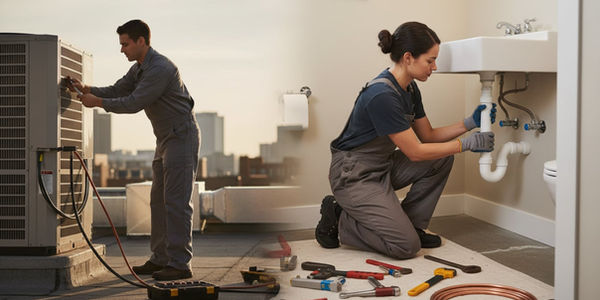
When something goes wrong with your home’s essential systems, knowing who to call can be confusing. Is that strange noise from the basement a job for a plumber or an HVAC technician? In the hvac vs plumbing debate, the core distinction comes down to two elements: water and air. Plumbers manage the systems that move water and gas, while HVAC technicians handle the systems that control your home’s air and climate. While both are masters of the skilled trades who keep our homes comfortable and safe, their expertise covers very different domains, and understanding the difference is key whether you’re a homeowner with an urgent issue or someone considering a new career path.
This guide breaks down everything you need to know, from job descriptions and tools to salaries and career outlooks, so you can confidently choose the right pro for the job.
The Core Difference: HVAC vs Plumbing Explained
At its simplest, the difference between hvac vs plumbing comes down to two elements: air and water.
Plumbers specialize in systems that move water and gas. Think of them as the experts for your home’s circulatory system. They manage the pipes that bring clean water in and take wastewater out.
HVAC technicians focus on systems that move air to control the climate. HVAC stands for Heating, Ventilation, and Air Conditioning. Their job is to manage your home’s respiratory system, ensuring you stay warm in the winter and cool in the summer.
While both trades involve pipes, mechanics, and ensuring home comfort, their specific systems, skills, and tools are not interchangeable. A plumber fixes your leaky faucet, while an HVAC tech repairs your broken air conditioner.
What Do They Actually Do? Job Descriptions Compared
Let’s look closer at the day to day responsibilities that define the hvac vs plumbing roles.
A Plumber’s Daily Grind
A plumber’s world revolves around pipes, fixtures, and drainage. Their primary duties include:
Installing and repairing pipes that carry water, gas, or waste.
Fixing common issues like leaky faucets, running toilets, and clogged drains.
Installing fixtures such as sinks, toilets, bathtubs, and showers.
Servicing and replacing water heaters, ensuring you have reliable hot water.
Clearing major blockages in sewer lines and addressing drainage problems.
Ensuring all work complies with strict local plumbing codes for safety and sanitation.
An HVAC Technician’s Typical Day
An HVAC technician’s focus is on climate control and air quality. Their main responsibilities involve:
Installing, maintaining, and repairing heating systems like furnaces and heat pumps.
Servicing cooling systems, including central air conditioners and ductless mini splits.
Working on ventilation systems and ductwork to ensure proper airflow.
Diagnosing and fixing complex issues involving electrical components, refrigerant levels, and mechanical parts like motors and compressors.
Performing routine maintenance to keep systems running efficiently and prevent breakdowns.
Improving indoor air quality by installing filters, humidifiers, and air purifiers.
Training and Certification: The Path to Becoming a Pro
The training paths for plumbers and HVAC technicians are distinct, each requiring specialized knowledge and hands on experience.
How to Become a Plumber
Most plumbers learn the trade through a formal apprenticeship. This is a long term commitment, typically lasting four to five years. An apprenticeship combines thousands of hours of paid, on the job training with classroom instruction on topics like blueprint reading, physics, and plumbing codes. After completing their apprenticeship, they must pass a state licensing exam to become a journeyman plumber, with many states requiring this license to work independently.
How to Become an HVAC Technician
The path to becoming an HVAC technician often starts at a trade school or community college, with programs lasting anywhere from six months to two years. A critical requirement for any HVAC tech is the EPA Section 608 Certification, which is legally required for anyone who handles refrigerants. This certification ensures technicians know how to handle these chemicals safely to protect the environment. Many technicians also pursue additional certifications like NATE (North American Technician Excellence) to demonstrate a higher level of expertise.
For aspiring techs looking for a flexible and affordable path, online platforms like SkillCat offer comprehensive training and even include the proctored EPA 608 exam. This modern approach allows you to learn the trade and get certified right from your phone, fitting your education around your life.
A Tale of Two Toolkits: Plumber vs. HVAC Tech Tools
You can tell a lot about the hvac vs plumbing professions by the tools they carry.
The Plumber’s Arsenal
A plumber’s truck is filled with heavy duty tools designed for cutting, gripping, and clearing pipes. You’ll find things like:
Pipe wrenches of all sizes
Pipe cutters, threaders, and benders
Soldering torches for copper pipes
Drain snakes and augers to clear clogs
Inspection cameras to see inside sewer lines
The HVAC Tech’s Gear
An HVAC technician’s toolkit is geared more towards electrical and refrigeration diagnostics. Their essential tools include:
A multimeter to test electrical circuits
A manifold gauge set to measure refrigerant pressure
A vacuum pump to remove moisture from refrigerant lines
Leak detectors to find refrigerant leaks
Sheet metal tools for working on ductwork
Who Do You Call? Common Household Scenarios
Knowing the difference between these trades helps you get the right expert for your problem, saving you time and money.
Signs You Definitely Need a Plumber
If your problem involves water or drains, a plumber is your best bet. Call a plumber for:
Leaky faucets or burst pipes
Clogged or slow drains
A constantly running toilet
No hot water or a leaking water heater
Low water pressure throughout the house
Sewer odors or backups
Signs It’s Time to Call an HVAC Technician
If your issue relates to air temperature or quality, an HVAC technician is the pro you need. Call an HVAC tech for:
Your air conditioner or furnace won’t turn on
The AC is blowing warm air
Strange noises like banging or screeching from your HVAC unit
Uneven temperatures, with some rooms being too hot or too cold
A sudden, unexplained spike in your energy bills
Poor indoor air quality or excessive humidity
The Gray Areas: Who Handles These Tricky Issues?
Some household systems can cause confusion, as they seem to overlap between the hvac vs plumbing domains.
Water Heaters: Is It a Plumbing or HVAC Job?
In almost all cases, a plumber handles water heater issues. Since a water heater’s primary function is to supply hot water to your plumbing fixtures, its installation, maintenance, and repair fall squarely in a plumber’s territory. They are trained to handle both the water connections and the gas or electrical components of these units.
Clogged AC Condensate Line: Plumber or HVAC Tech?
This is a classic crossover issue. An AC condensate line drains excess moisture from your air conditioner. Typically, an HVAC technician is the first person to call for a clog. It’s part of the AC system they regularly service. However, if the condensate line is tied directly into your home’s plumbing system, a deep clog might require a plumber’s specialized tools to clear. A good rule of thumb is to start with an HVAC tech, and they can tell you if a plumber is needed.
Career Deep Dive: A Look at HVAC vs Plumbing Jobs
For those considering a career in the trades, comparing hvac vs plumbing jobs is a critical step.
Salary Comparison: Who Earns More?
Both trades offer strong, stable incomes. According to the U.S. Bureau of Labor Statistics (BLS), plumbers have a slight edge.
The median annual wage for plumbers was $62,970 in May 2024.
The median annual wage for HVAC technicians was $59,810 in May 2024.
However, salaries vary widely based on location, experience, union status, and specialization. An experienced technician in either field, especially one who owns their own business, can earn a six figure income.
Job Outlook: Which Trade is in Higher Demand?
The job outlook is excellent for both professions, but HVAC is growing at a faster rate. The BLS projects that employment for:
HVAC technicians will grow 8% from 2024 to 2034, much faster than the average for all occupations. This growth is driven by new construction and the need to replace older, less efficient systems.
Plumbers will grow 4% during the same period, which is about average. New buildings and aging infrastructure will continue to create a steady demand for plumbers.
Career Paths and Advancement
Both trades offer significant opportunities for career growth. A technician can advance from an apprentice to a journeyman and eventually a master of their trade. Other advancement paths include:
Specialization: Focusing on specific areas like commercial refrigeration for HVAC or medical gas piping for plumbing.
Management: Becoming a foreman, project manager, or service manager.
Entrepreneurship: Starting your own HVAC or plumbing contracting business.
Continuous learning is key to advancement. Gaining new skills and certifications can open doors to higher paying roles. With resources like SkillCat, you can upskill at your own pace, adding valuable credentials to your resume.
The People Behind the Trades: Skills and Work Life
What does it take to succeed in these fields, and what is the work really like?
Essential Skills for Plumbers and HVAC Techs
Success in both fields requires a strong foundation of practical skills, including:
Mechanical Aptitude: A natural understanding of how systems work.
Problem Solving: The ability to diagnose complex issues and find effective solutions.
Physical Stamina: Both jobs are physically demanding and require lifting heavy equipment and working in uncomfortable positions.
Customer Service: Strong communication skills are essential for interacting with clients.
Beyond these shared traits, HVAC techs need a solid understanding of electricity and thermodynamics, while plumbers must be experts in fluid dynamics and local building codes.
Working Conditions and Hours
Be prepared for challenging work environments. Plumbers often deal with wet, messy conditions in tight crawlspaces. HVAC techs frequently work in extreme temperatures, like scorching hot attics or freezing cold rooftops. For safety basics, many new techs review an OSHA-10 course guide.
Both professions often require working outside of a typical 9 to 5 schedule. Emergency calls for a burst pipe or a broken furnace can come at any time, so being on call for nights and weekends is common.
Better Together: When Plumbers and HVAC Techs Collaborate
While their roles are distinct, plumbers and HVAC technicians often work together, especially on large projects like new home construction. They must coordinate to ensure that ductwork and plumbing lines can run through walls and floors without interfering with each other. This collaboration ensures that all of a building’s mechanical systems are integrated seamlessly and function correctly.
Frequently Asked Questions about HVAC vs Plumbing
Can a plumber do HVAC work?
Generally, no. A licensed plumber is not certified to handle refrigerants or the complex electrical systems in HVAC units. The skills and required certifications for the hvac vs plumbing trades are separate.
Which trade is harder to learn?
Neither is “easy”, and both require years to master. Plumbing often involves a longer apprenticeship and more physically demanding labor from the start. HVAC requires a deeper understanding of technical concepts like electricity and thermodynamics, which can be challenging for some.
Is HVAC or plumbing a better career choice?
Both are excellent career choices with high demand and strong earning potential. The “better” choice depends on your personal interests. If you enjoy solving mechanical puzzles and working with complex systems, HVAC might be a great fit. If you prefer more straightforward, hands on construction and repair, plumbing could be your calling.
What is the biggest misconception in the HVAC vs plumbing debate?
The biggest misconception is that the skills are easily transferable. While both are mechanical trades, a master plumber cannot simply start working on an air conditioner, and an expert HVAC tech is not qualified to install a home’s entire drainage system. They are distinct and specialized professions.
How can I start training for a career in HVAC or plumbing?
For plumbing, look for apprenticeship programs through local unions or contractors. For HVAC, a great first step is to enroll in a training program to gain foundational knowledge and your EPA 608 certification. Online options like SkillCat provide an accessible and affordable way to get started on your journey into the skilled trades today.